How Campus Infrastructure Impacts Student Enrollment Decisions


59% of Students Say Sustainability Affects Where They Apply. Where Does Your Campus Rank?
Survey data is reshaping how higher education leaders think about campus infrastructure, and the frameworks measuring institutional progress are getting more rigorous.
In its 2025 College Hopes & Worries Survey, The Princeton Review asked more than 7,000 college applicants and their families a simple question: does a college’s commitment to the environment affect your decision to apply or attend?
59% said yes.
A separate Inside Higher Ed Student Voice survey reinforced the trend:
- 45% of undergraduates considered sustainability in their enrollment decision
- 85% said it’s at least somewhat important for their campus to prioritize it.
- Half of those students named energy use as the area most in need of more progress on their campus.
The signal is consistent. Campus sustainability has become an enrollment factor, and a measurable one.
The frameworks that actually track progress
Public commitments are easy. Measurable progress is harder, and institutional rankings have become more demanding.
The Association for the Advancement of Sustainability in Higher Education (AASHE) operates STARS — the Sustainability Tracking, Assessment & Rating System — the framework most widely used by higher education sustainability officers. More than 668 institutions across 29 countries report through STARS, earning Bronze, Silver, Gold, or Platinum ratings based on transparent scoring across Academics, Engagement, Operations, and Planning & Administration.
The 2025 Sustainable Campus Index tells a clear story about where the bar is moving. Average overall scores sit at 58.7%, with most schools holding substantial room to grow. The Energy & Climate impact area — covering energy consumption, renewable energy, and greenhouse gas reduction — averages just 47% across all institutions, the weakest category for most schools. It’s also the area where infrastructure investment translates most directly into ranking improvement.
The gap between commitment and capital plan
Most institutions already have a public sustainability commitment. Many have signed onto carbon neutrality targets with dates between 2030 and 2050.
The harder question is what’s funded.
The infrastructure projects that would actually deliver those commitments — central plant electrification, building envelope upgrades, controls modernization, on-site generation, deep energy retrofits — compete for the same constrained capital dollars as academic buildings and residence halls.
The result is a widening gap between the public pledge and the executable plan.
How infrastructure becomes a sustainability asset
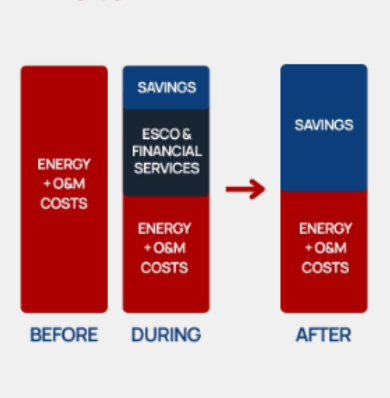
Self-funded financing models solve this funding problem. Energy as a Service (EaaS) — where a partner designs, finances, builds, and operates the upgrades for a fixed service fee — has become the preferred path for many institutions, particularly those that have already worked through one or more Energy Savings Performance Contracts (ESPCs). Both models allow institutions to modernize aging systems and add new sustainable infrastructure — funded through the guaranteed energy and operational savings the projects produce. No upfront capital. No competition with academic priorities.
These are also the exact project types that move STARS Energy & Climate scores: central plant electrification, renewable generation, building controls modernization, deep retrofits. The infrastructure work and the sustainability outcome are the same project, told two different ways.
That’s what happened at CalTech.
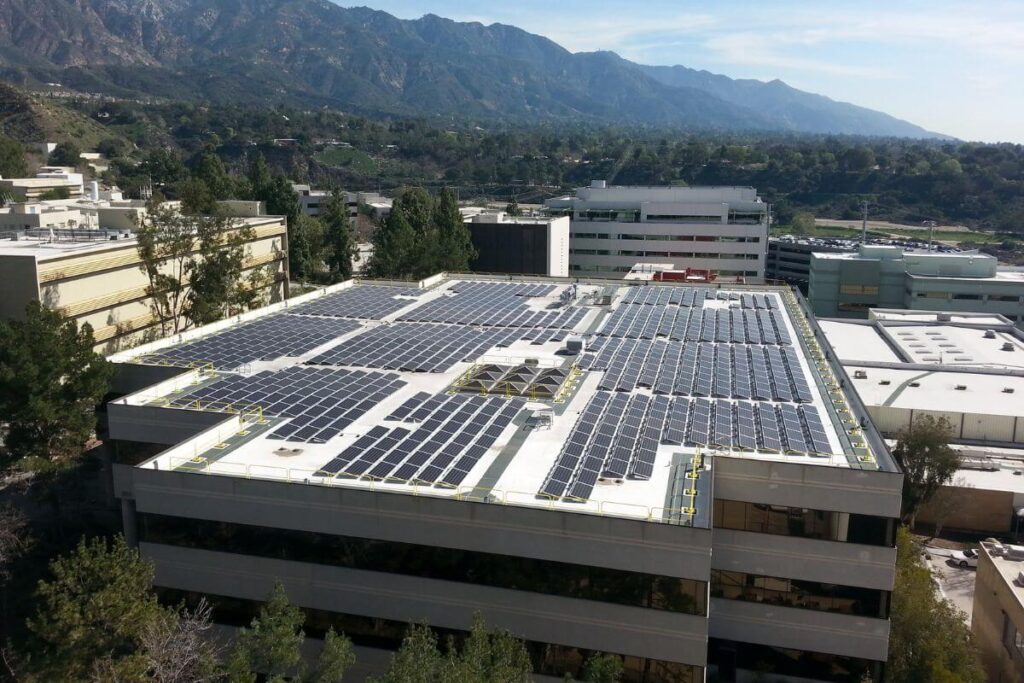
The NASA Jet Propulsion lab at CalTech leveraged the ESPC model to cut its annual water use by 25% and energy use by 38% across 128 buildings, while incorporating renewable energy sources and improving data center efficiency. Whether structured as an ESPC or EaaS, the principle is the same: sustainability improvements that pay for themselves.
What this means for institutional leadership
For Presidents, Provosts, and Trustees, the data signals that campus sustainability has moved from a values conversation to a competitive one. Schools that demonstrate measurable progress will increasingly be the schools that win on yield.
For CFOs and Facilities leaders, the deferred maintenance backlog and the sustainability commitment are not separate problems. The aging central plant on the capital plan is the same project that, properly structured, becomes the institution’s most visible sustainability achievement — and the largest single contributor to a higher STARS score.
____________________________________________________________________________________
Want to rise up the sustainability rankings without drawing from your capital budget? CEG Solutions has delivered more than $1B in projects across higher education, federal research campuses, and public sector clients — with infrastructure modernization that funds itself through guaranteed energy and operational savings.
Related Posts

In energy-intensive segments like food processing, energy costs can account for 15 to 30 percent of total operating expenses. The challenge isn’t awareness….

Hospitals are designed to withstand clinical emergencies. What they’re often not designed to withstand is the failure of…
-
Deferred maintenance is often framed as a facilities problem: aging equipment, failing systems, or overdue repairs. But in…