
From Deferred to Funded: Moving Stalled Facility Priorities Forward in Colorado

By Will Benish, CEG-Iconergy
The plan already exists. Here is how Colorado local governments put the projects they have already identified on a path to funding, and enable a predictive maintenance plan, rather than a reactive one.
Most local governments already know what needs fixing
The U.S. Department of Energy reports that 80% of state and local government buildings are more than 20 years old, and this comes as little surprise to those that run them.
Nearly every county, city and town in Colorado already has a good picture of what its facilities need. The facility condition assessment, the master plan, the capital improvement plan, or the running list a public-works director keeps in a spreadsheet has already named it. Courthouse HVAC nearing the end of its service life. Detention-facility controls that should have been modernized two budget cycles ago. Roofs, boilers, lighting and public-works systems that keep moving from “this year” to “next year.”
Most local governments already know what their facilities need. The harder question is how to fund and deliver it.
Why documented priorities keep sliding to next year
Facility projects rarely stall because they lack value. They stall because several legitimate pressures collide:
- A courthouse boiler remains operational, even if it is increasingly unreliable.
- Controls at a jail or justice center need attention, but other public-safety expenses take priority.
- An HVAC replacement has been identified, but the available capital budget cannot absorb it this year.
- A grant or incentive that was expected to help fund the work is delayed, reduced or unavailable.
- A small facilities team is managing daily work orders and emergency repairs while also being asked to develop major capital projects.
None of this reflects poor planning. It reflects the real constraints of running a local government with finite dollars and lean staff. Deferral may resolve the immediate budget decision, but it does not hold the surrounding costs in place.
The operational cost of staying reactive
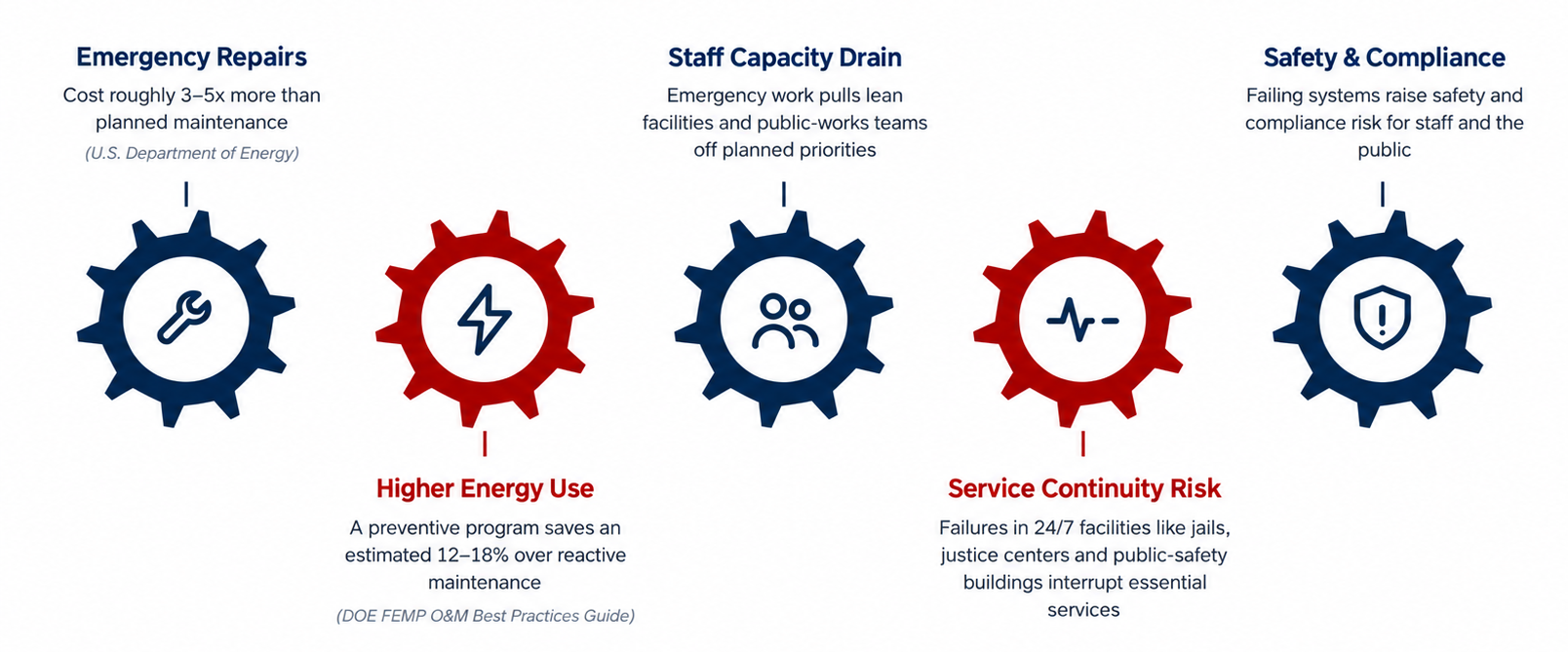
Reactive maintenance can feel like the most practical option when staff and funding are limited. Equipment is repaired when it fails, and systems are kept running for another budget cycle.
That approach can carry a meaningful cost: emergency repairs can cost 3-5x more than planned maintenance estimates. Reactive approaches average 8.43% more annual downtime. Degraded equipment consumes 15-30% more energy than optimal.
Organizations that adopt of a preventive maintenance approach, on the other hand, see the payoff: lower repair costs (and fewer of them), efficient systems, and shrunken utility bills.
Start with the plan you already have
Moving forward does not require another exercise that recreates the existing project list. The FCA, master plan or CIP provides the starting point.
The next step is to evaluate documented needs across the broader portfolio using factors such as:
- Asset condition and remaining useful life
- Mission criticality and consequences of failure
- Maintenance burden and staff impact
- Utility consumption and operating costs
- Existing studies, designs and procurement work
- Available capital, incentives and funding structures
A 24/7 justice facility carries a different risk profile than an administrative building. Likewise, a controls project with meaningful operating savings may have a different funding path than a roof replacement with limited savings.
A portfolio path from plan to funded project
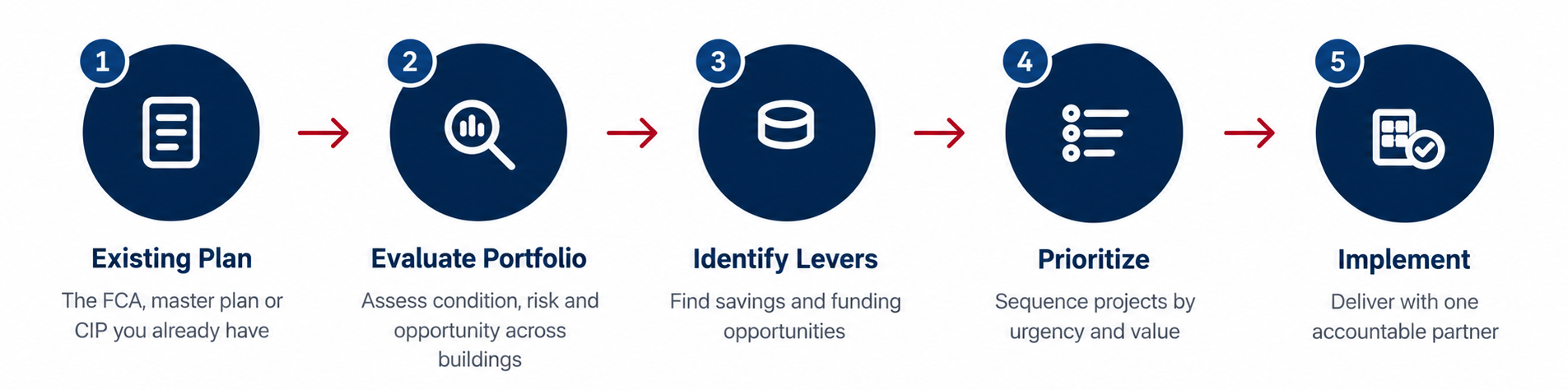
The path starts with the plan you already own and ends with delivered work. In between, the portfolio is evaluated so you can see condition, risk and opportunity across your buildings, financial and operational levers are identified, and projects are sequenced so the most urgent and highest-value work moves first.
Match each project with the right path
Some priorities require direct capital because they carry limited savings but significant safety, reliability or public-service value. Other projects may contain enough utility savings, maintenance savings or related facility scope to support a different approach.
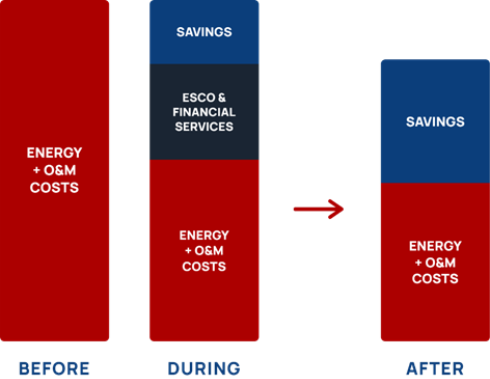
For qualifying work, an energy performance contract (EPC) is one path worth evaluating. It starts with an IGA, an engineering study that develops and validates the scope, expected performance and savings a project can produce. Where the numbers work, the project can be funded through the savings it creates over time.
EPC is one tool in the kit, not the only one. CEG-Iconergy also delivers true design-build, Energy-as-a-Service, capital planning, facility condition assessments, decarbonization plans, climate action plans and operational success plans that help organizations get ahead of their facility goals and targets. We match the delivery model to the project rather than the other way around, and structure, procurement and financing are reviewed case by case so each project lands on the right path.
Other projects run well on budgeted capital, grants, utility incentives, lease-purchase or a combination of sources. Colorado procurement, appropriation, TABOR and financing rules should be reviewed for your specific organization and project.
A single accountable team can also add capacity you don’t have in-house: validating information, developing scope, coordinating implementation, pursuing funding and measuring results. For a stretched facilities or Public Works department, that continuity can matter as much as the projected savings.
What facility modernization looks like in Colorado
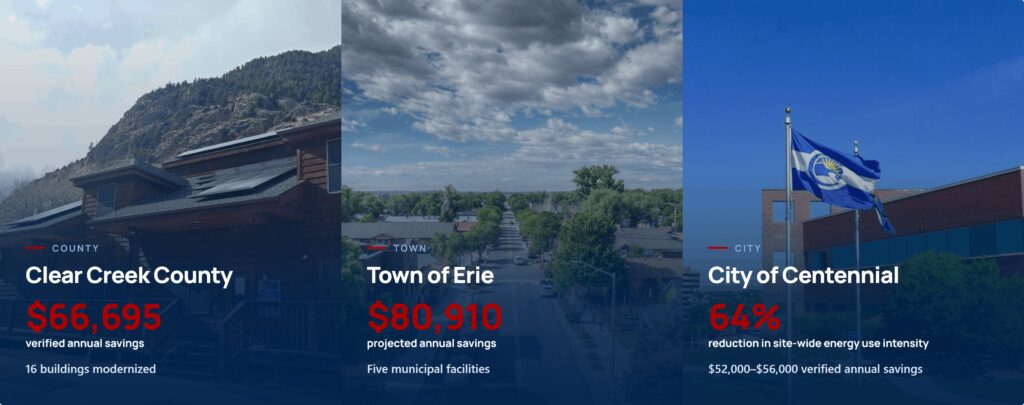
Clear Creek County
Clear Creek County evaluated needs across 16 county-owned buildings through an Investment Grade Audit and developed a $2.63 million performance contracting and design-build program.
The scope included HVAC replacements, lighting, building automation and controls, ventilation, weatherization, solar PV and additional energy- and water-saving measures. The team also helped secure a DOLA grant.
The program has achieved $66,695 in verified annual savings while reducing utility use, minimizing unplanned repair costs and improving comfort and controllability.
One accountable partner, less reactive workload
A large facilities program adds coordination work that lean teams do not always have the capacity to absorb. Working with one accountable partner to coordinate assessment, design, construction, measurement and reporting keeps that load off internal staff and gives a single point of ownership for results. As a vendor and technology neutral partner, CEG-Iconergy recommends the systems and measures that fit your facilities rather than a fixed product line.
Related Posts

By Chrissy Sherriff · CEG Solutions The short version: most districts are still planning and budgeting for the indoor air…

Learn how CEG delivered significant additional energy savings at already highly efficient buildings with our proven

CEG can deliver holistic energy upgrades to any federal agency at no upfront cost using the


